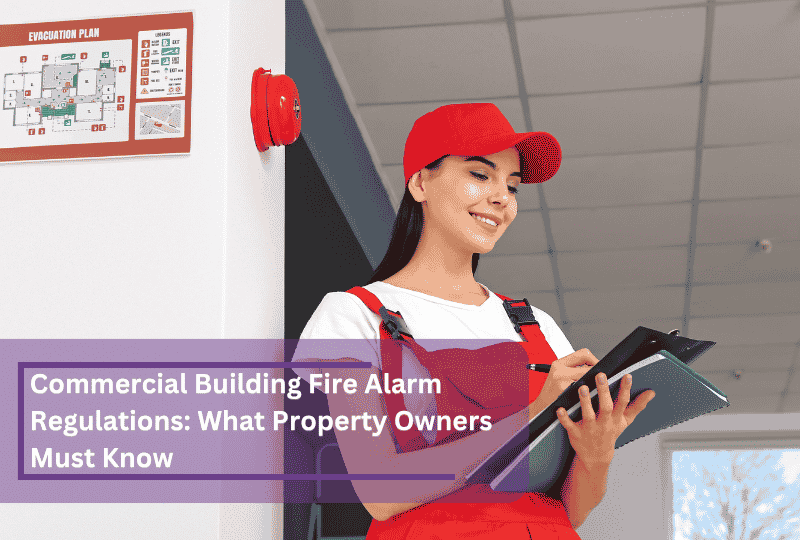
Fire safety is essential in any property. It saves lives, protects the building, and helps ensure the property remains compliant and fit for tenants.
For a commercial building, fire safety is not optional. It is a legal requirement, and in Scotland, the rules are clear. Whether you own an office block, run a care home, or manage an industrial space, the law places a direct duty on you to ensure your building has a suitable fire detection and alarm system in place.
Unlike residential properties, commercial buildings do not follow a single prescriptive list of alarms. Instead, the law requires every commercial property to have its fire risks properly assessed and a system installed that matches those risks. If these requirements are not met, it can lead to enforcement action, including formal notices and, in more serious cases, legal penalties.
In this blog, we will guide you through the laws that apply to commercial buildings, who is legally responsible, what type of fire alarm system your building needs, and what you face if you fall short of the standard.
Why Fire Alarm Compliance Matters in Commercial Buildings
Fire can escalate from a small ignition to life-threatening conditions within minutes. In a building with employees, customers, or sleeping occupants, a properly designed fire alarm system gives everyone the maximum possible time to evacuate safely. The earlier a fire is detected, the more time occupants have to reach safety, and the lower the risk of serious injury or death.
The level of risk varies by business type. In multi-tenant or mixed-use commercial properties, the overall fire risk is generally higher. A compliant system also reduces false alarms that disrupt operations and waste Scottish Fire and Rescue Service resources.
For commercial property owners, the consequences of non-compliance go well beyond safety:
- Legal action: Non-compliance under the Fire (Scotland) Act 2005 can result in enforcement notices, prohibition orders, unlimited fines, and up to two years’ imprisonment.
- Insurance: A non-compliant or poorly maintained system can void coverage entirely, leaving the property fully exposed in the event of a claim.
- Business continuity: A major fire without adequate protection can force permanent closure; 80% of affected businesses do not recover within 18 months.
- Reputation: A safe, compliant building protects assets and builds trust with employees, customers, and regulators
From April 2026, the Building (Scotland) Amendment Regulations 2025 will also introduce stricter requirements for hotels, hostels, and similar accommodation. Under Scottish law, the person in control of the building bears full legal responsibility if a fire occurs and the alarm system proves inadequate.
Key Fire Safety Laws and Standards for Commercial Buildings
Commercial fire alarm compliance in Scotland is built on two main legal frameworks. Understanding how they work together is essential for meeting your legal duties.
The Fire (Scotland) Act 2005
The main law regarding fire safety in non-domestic premises in Scotland is outlined in this act. Part 3 of the act focuses on commercial buildings and places a clear legal duty on the responsible person to ensure fire safety measures, including alarm systems, are adequate and properly maintained.
The key provisions every commercial property owner must know are the following:
- Section 53 places a general duty on the Responsible Person to take all reasonable and practicable fire precautions to ensure the safety of relevant individuals on or near the premises.
- Section 54 requires the Responsible Person to carry out a suitable and sufficient fire risk assessment, identifying risks to relevant individuals and the fire safety measures needed to address them.
- Section 56 sets out the prevention principles that must be applied when implementing fire precautions, including eliminating risks at source and prioritising collective protective measures.
- Section 57 requires fire safety arrangements to be recorded in writing where the premises employ five or more people or where a licence is in force, such as an HMO licence.
The Act is enforced by the Scottish Fire and Rescue Service, which holds full powers to inspect, enforce, and prosecute.
The Fire Safety (Scotland) Regulations 2006
These regulations supplement the 2006 Act and provide more detailed requirements for carrying out fire safety duties in practice. These cover the maintenance of fire-fighting equipment and alarms, the provision of fire safety information to employees, procedures for serious and imminent danger, and arrangements for contacting emergency services.
Regulation 10 specifically requires that fire detection and alarm systems be subject to adequate maintenance and testing. The law mandates ongoing system upkeep, making it a direct legal obligation rather than merely a best-practice recommendation.
Who Is Responsible for Fire Alarm Compliance for Commercial Buildings?
The individual who has control of the building, typically the building owner, employer, managing agent, or lease-holding occupier, is the responsible person for fire alarm compliance in commercial buildings.
Some of the key responsibilities include:
- Carrying out and maintaining a fire risk assessment and putting appropriate fire safety measures in place based on the findings.
- Ensuring the fire alarm system is installed to BS 5839-1 by a competent person.
- Testing the alarm system weekly and arranging professional servicing at least every six months, as required under Regulation 10.
- Keeping accurate records of all testing and servicing in a fire alarm log book.
- Making sure staff and regular occupants are trained in fire safety procedures specific to the premises, including how to raise the alarm, where escape routes are, and where to assemble.
Where a managing agent operates on behalf of you, the agent typically takes on the day-to-day responsible person duties. However, you still retain liability if the agent fails to meet those obligations. Shared responsibility does not dilute accountability.
Fire Alarm Requirements for Commercial Buildings in Scotland
Commercial fire alarm requirements are not one-size-fits-all. The type of system a building needs depends on its fire risk assessment, the nature of its occupancy, and the level of protection required. A small, low-footfall office has very different needs from a care home or a multi-tenant warehouse.
BS 5839-1:2025 is the code of practice that governs the design, installation, commissioning, and maintenance of fire detection and alarm systems in all non-domestic premises in Scotland. It classifies systems based on what they are designed to protect: life, property, or both. The fire risk assessment determines which category applies to your building.
To make this clearer, the standard groups fire alarm systems into defined categories. Each category reflects a different level of coverage and purpose.
Category (Manual)
It is a manual system, with no automatic detection. Occupants raise the alarm by activating a call point when they discover a fire. This system is only suitable for very small, low-risk premises where all areas are under constant observation and any fire would be identified immediately without the need for automatic detection.
Category L (Life protection)
Category L systems use automatic detection to protect people, raising the alarm as early as possible and giving occupants the maximum time to evacuate. The sub-categories reflect how much of the building is covered.
- L1: Full building coverage with automatic detection.
- L2: Covers escape routes and high-risk areas.
- L3: Covers escape routes only.
- L4: Covers circulation areas such as corridors and stairwells.
- L5: Covers specific areas only, based on identified risks.
Higher-risk buildings, especially those where people sleep or need assistance to evacuate, require higher-category systems.
Category P (Property protection)
Category P systems are designed to limit property damage and reduce business disruption. They detect fire automatically but are focused on protecting the building and its contents rather than primarily on life safety.
- P1: Full building coverage with automatic detection throughout
- P2: Covers specific high-risk areas only.
Each category reflects a different level of risk, and the correct system depends on how your building is used.
Fire Alarm Regulations by Building Type
Fire alarm requirements vary depending on how a building is used and the level of risk involved. While the fire risk assessment defines the exact system needed, the type of building gives a clear starting point for what level of protection is expected.
Commercial Buildings
Standard commercial premises, such as offices, business parks, and professional service buildings, typically require a Category L3 or L4 system covering escape routes and circulation areas.
Larger or multi-storey buildings often require broader coverage at Category L2. Weekly testing, six-monthly servicing, and a current fire risk assessment are essential regardless of building size.
Mercantile Complexes
Buildings with high footfall and multiple occupiers carry a higher level of risk. Retail units, shopping centers, and mixed-use developments typically require Category L2 or L1 systems that include automatic detection throughout all areas, including storage spaces and service corridors.
Where multiple occupiers share the premises, the system must integrate with central building management systems.
Healthcare Facilities
Where occupants may not be able to evacuate independently, a higher level of protection is required. Such as GP surgeries, dental practices, clinics, and hospitals generally require Category L1 systems. Smoke detectors are needed in areas where patients sleep or rest, and alarm systems must link with staff response procedures to support a coordinated evacuation.
Industrial Complexes
Fire risks increase in environments involving machinery, stored materials, and heat processes. Warehouses, factories, and distribution centres often require a combination of Category P systems for property protection and Category L systems for occupied areas.
Detection must be suitable for the environment, as standard smoke alarms may not perform well in dusty or high-temperature conditions.
Educational Facilities
Buildings with large numbers of occupants and complex layouts require clear and reliable detection systems. Schools, colleges, and universities typically require Category L1 or L2 systems with full automatic detection. Systems must also allow straightforward testing to support regular fire drills without unnecessary disruption.
Correctional Facilities
Prisons and secure facilities require carefully managed evacuation. Category L1 systems with automatic monitoring are typically required, along with integration into staff control procedures, to ensure that evacuation protocols are effective and that all individuals can be safely accounted for during an emergency. Fire risk assessments must reflect the constraints of locked and controlled environments.
Assembly Occupancies
Venues such as theatres, stadiums, and places of worship involve high occupant density and unfamiliar layouts. These buildings usually require Category L1 or L2 systems, often with voice alarm capability to give clear evacuation instructions. The system must perform effectively during peak occupancy.
Size and Occupant Load of the Building
The size of the building and the number of occupants directly affect the level of protection required:
- Larger buildings with high occupancy typically require Category L1 or L2 systems with addressable panels.
- Smaller, low-risk buildings may meet requirements with Category L4 or L5.
Any change in building size or occupancy should trigger a review of the fire risk assessment and the alarm system in place.
Installation, Testing, and Maintenance Requirements
Fire alarm systems must not only be installed correctly but also tested and maintained on an ongoing basis to remain compliant.
- Installation: Must be carried out by a competent person, such as a BAFE- or Fire Industry Association-certified engineer. A design certificate should be issued once the installation is complete.
- Weekly testing: Required under Regulation 10 of the Fire Safety (Scotland) Regulations 2006. At least one manual call point must be activated each week, rotating through all call points over time. Each test must be recorded in the log book for the fire alarm system, including the date, time, call point tested, and system response.
- Six-monthly servicing: A qualified engineer must inspect the system every six months. The servicing includes checking detectors, call points, sounders, control panel functions, backup batteries, and cabling. Service reports must be kept in the logbook.
- Faults and repairs: Any faults identified must be fixed promptly. Leaving a known issue unresolved is a direct breach of the Responsible Person’s legal duty.
What Happens If You Do Not Comply?
The Scottish Fire and Rescue Service can inspect any non-domestic premises at any time under the Fire (Scotland) Act 2005. If they find deficiencies, they can issue an enforcement notice requiring remedial action within a set timeframe. If the risk to occupants is immediate, a prohibition notice prevents the building from being occupied until the issue is resolved.
Failure to comply with an enforcement notice, or a serious breach of the Fire (Scotland) Act 2005, can lead to criminal prosecution. Convictions carry unlimited fines and up to two years’ imprisonment. Building and liability insurance can also be invalidated where the system does not meet the required standard.
Commercial Fire Alarm Compliance Checklist
Staying compliant involves more than installing a system. It requires ongoing checks across legal duties, system setup, and day-to-day safety measures. This checklist highlights the key areas to review.
Legal and Assessment
- Fire risk assessment completed by a competent person and is up-to-date
- Assessment reviewed following any change to building layout, occupancy, or use
- The fire alarm category matches the assessment findings
System Installation
- Installed by a BAFE or FIA-certified competent person
- Design Certificate issued and retained on file
- All cabling is fire-resistant; mains cables are coloured red
- The zone plan is displayed at the control panel and on any repeater panels
- Sleeping areas protected by smoke detectors, not heat detectors
- Unused detectors and wiring should be removed from the system
Testing and Maintenance
- A weekly manual call point test should be conducted and recorded in the logbook.
- Six-monthly professional service completed; reports retained
- All faults recorded and remedied promptly
Occupant Safety
- Staff trained in fire procedures specific to the premises
- Escape routes are signed, clear, and unobstructed
- Personal emergency evacuation plans in place where required
Conclusion
Fire alarm commercial building compliance in Scotland is not about meeting a simple checklist. It is about making sure the system in place matches the real risks within the building and continues to perform when it matters most.
For commercial properties, fire alarm regulations require a risk-based approach, supported by proper installation, regular testing, and ongoing maintenance. Responsibility sits clearly with the person in control of the premises, and the legal and financial consequences of getting it wrong are significant.
If you are unsure where alarms should be placed or what your building requires in Dundee and the surrounding areas, Westport Property can guide you. With over 13 years of experience in property management, we help ensure your systems are correctly installed and fully compliant, and your property and tenants are protected from fire risk.
Have A Question or Need Some Help?
Whether you're searching for the perfect rental property or a landlord wanting advice on letting, we're here to assist. Feel free to call our office or send us an email, and we'll be happy to help you with any queries you may have.
Frequently Asked Questions
What type of fire alarm system is most commonly installed in commercial buildings?
The most widely used system in Scottish commercial buildings is an automatic fire detection and alarm system at Category L2 or L3 under BS 5839-1:2025, combining smoke detectors, manual call points, a control panel, and sounders. Higher-risk premises such as care homes and hotels typically require a fully addressable Category L1 system.
How frequently should fire alarms be tested in a commercial property?
Manual call points must be tested weekly, rotating across all call points over time. A full professional service must be carried out every six months by a certified engineer. All testing and servicing must be recorded in a fire alarm log book kept on site.
Is it a legal requirement to have a fire alarm in every commercial building?
Yes. Under the Fire (Scotland) Act 2005, every non-domestic premises in Scotland must have appropriate fire detection and warning measures in place. The exact system required depends on the building's size, occupancy, and fire risk assessment findings.
How much does a fire alarm system cost for a commercial building?
Costs vary depending on building size and system category. A basic system for a small office can start from around £500 to £1,500. A fully addressable system for a larger or high-risk premises can range from £5,000 to £20,000 or more. Six-monthly professional servicing typically costs between £150 and £500 per visit.
 Find a Property Sale/Rent
  Property Management
  Tenant Background Screening
  Rent Collection
  Property Maintainance
  Property Inspection
  Property Advertising
  Portfolio Management For Landlords
  Investment & Asset Management